


Curriculum/Degree Requirements
Curriculum/Degree Requirements
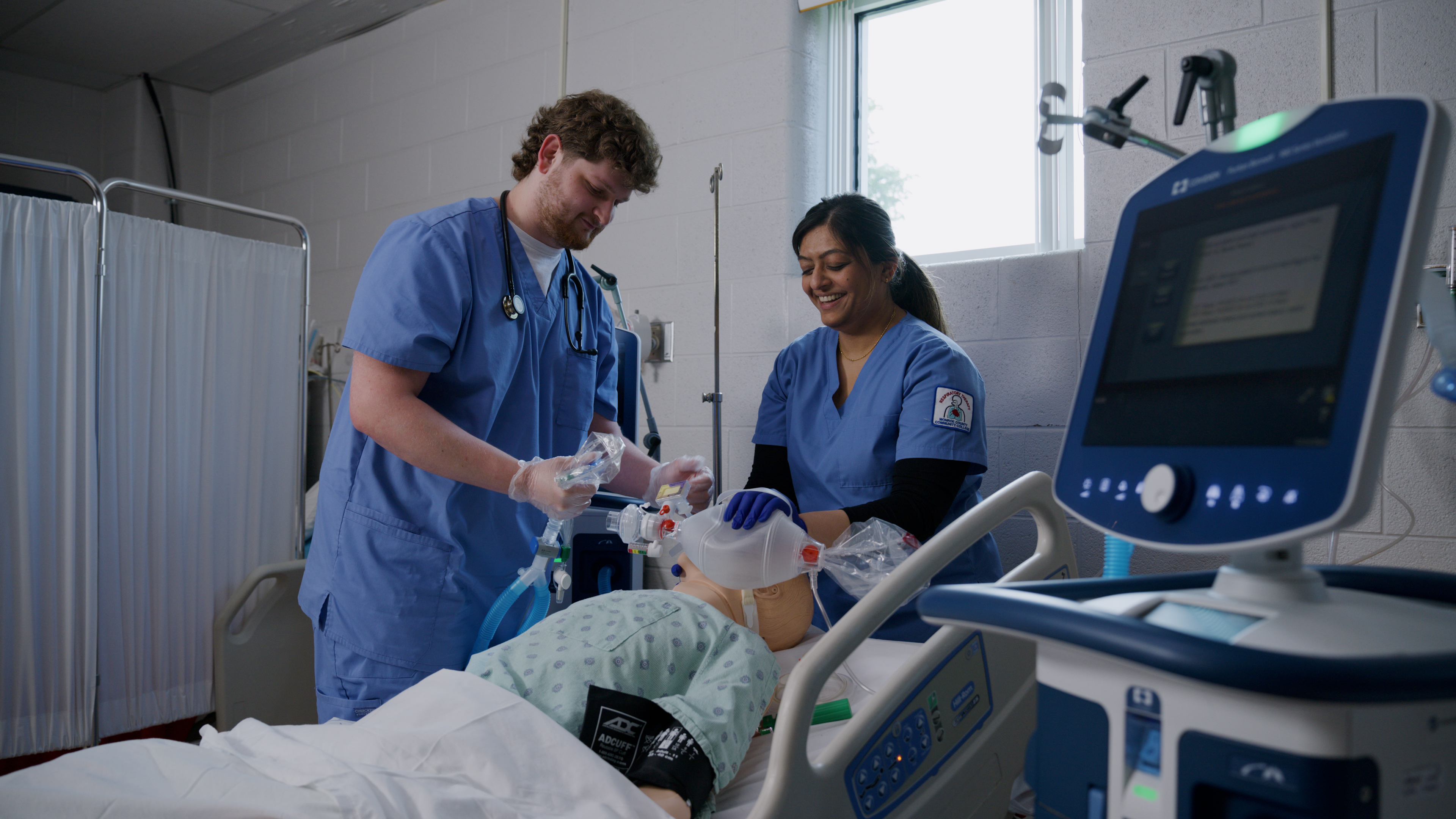
Respiratory therapy, or respiratory care, is an allied health profession specializing in cardiopulmonary diseases. A respiratory therapist can be instrumental in assisting in the diagnosis, treatment and prevention of a wide spectrum of disorders affecting the heart and lungs.
A registered respiratory therapist (RRT) requires a minimum of a two-year degree, and most RRTs work in a hospital. Monroe County Community College respiratory therapy program graduates exceed the national averages for success on board exams.
APPLICATION DEADLINE: The respiratory therapy program follows a selective admission process. To be eligible for evaluation and selection, all required information must be included in the student’s folder by the application deadline, which is the last Thursday in June of the year the student wishes to enter the program.
In accordance with federal, state, and institutional policies, the Monroe County Community College Respiratory Therapy Program does not discriminate in its student admissions, faculty employment, or any other aspect of its operations on the basis of race, color, religion, sex (including pregnancy, sexual orientation, and gender identify), national origin, age, disability, genetic information, veteran status, height, weight, or any other protected characteristic under applicable law.
Admissions Selection Criteria
The respiratory therapy program is a selective admissions program. Respiratory therapy program applicants must meet established minimum criteria to be considered. The respiratory therapy applicant needs to be aware meeting the minimum standards does not ensure admission to the program. Up to thirty students with the highest number of points are selected each year and tend to be well qualified having exceeded the minimum standards in some, if not all, of the criteria.
- Graduation from high school or successful completion of the G.E.D. (General Education Development) test.
- Completion of MATH 105 or MATH 151 or MATH 154 or higher-level math with a “C” or better; or a qualifying score on accepted placement test as determined by the college; or equivalent transferred course. It is required that these accepted courses be repeated if they have not been taken within 10 years of the application deadline unless the applicant is able to show proficiency on an accepted placement test. The older math grade will be used to calculate points if these conditions are met.
- Completion of BIOL 257 Anatomy and Physiology I or equivalent with a “C” or better. It is required that anatomy and physiology be repeated if it has not been taken within 10 years of the application deadline. Students who have taken anatomy and physiology at another accredited institution of higher learning that does not transfer as equivalent to the MCCC course will have their course(s) evaluated on an individual basis.
- Official transcripts from high school sent to the MCCC Admissions office. Official transcripts from all colleges or universities, if transfer credit is desired, sent directly to the MCCC Registrar’s office.
- Tests such as the TOEFL or other accepted tests as determined by the college may be required to show proof of English language proficiency for individuals whose native language is not English.
Respiratory therapy applicants will we awarded points based upon the following criteria:
- Grades in math and anatomy & physiology
- Grades from additional (non-required) college math and science courses
- Credits earned at MCCC
- Transfers from specialized degree programs, such as a 1+2+1 program
- Residency status
- Attendance at a Respiratory Therapy Information Session and/or Hospital Tour within two years
- Work experience in a health care occupation or advanced health credentials/licenses
- Academic credentials of an associate, bachelor, or master degree
Applicants enrolled in any pre-requisite classes that finish after the deadline but before the start of fall semester may still be considered for admission to the program contingent upon completion with “C” or better in the missing pre-requisite class(es). However, the total points for admission will be considered only for coursework that is completed by the application deadline. A rank ordered list of respiratory therapy applicants by point total will be created. Up to thirty (30) applicants with the highest number of points will be granted admission to the Respiratory Therapy Program. A group of up to fifteen (15) applicants with the next highest number of points will be placed on an alternate’s list in the event of a vacancy for the program.
Points are calculated based upon the following criteria:
1. Math grade (MATH 105, 151, 154 or higher) and degree of difficulty
| Points | Grade |
|---|---|
| 5 | A |
| 4 | Placement Testing at or above MATH 105 |
| 3 | B |
| 1 | C |
+1 added to the above grade points if the course is MATH 157 or higher MATH 156 or 166 do not satisfy the Respiratory Therapy Program math pre-requisite If a student takes MATH 151 and a higher-level math (e.g. MATH 157), which ever condition that awards the highest number of points will be used for the point determination.
2. BIOL 257 Anatomy and Physiology I grade
| Points | Grade |
|---|---|
| 5 | A |
| 3 | B |
| 1 | C |
3. BIOL 258 Anatomy and Physiology II grade (This is not a requirement to enter, but applicants can earn extra points for completing prior to starting the program and it is highly suggested to complete prior to admission)
| Points | Grade |
|---|---|
| 5 | A |
| 3 | B |
| 1 | C |
4. The following courses are not a requirement to enter nor are they in the curriculum. However, they may be part of a transfer degree and they represent useful knowledge for respiratory therapy students. Applicants can earn +1 point for completion with a C or better prior to starting the program in any or all of the following:
BIOL 259 Introduction to Pathophysiology
BIOL 260 Microbiology
BIOL 264 Fundamentals of Genetics
CHEM 150 Fundamental Principles of Chemistry or higher (excludes CHEM 155)
PHYS 151 General Physics or higher
5. Total number of credit hours taken at MCCC:
| Points | Grade |
|---|---|
| 3 | 25 or more credits |
| 2 | 13-24 credits |
| 1 | 1-12 credits |
| 0 | no MCCC credits |
6. Transfer credits from a Respiratory 1+2+1 Program:
5 points
7. Residency status as of June 1:
| Points | Location |
|---|---|
| 2 | Monroe County |
| 1 | Michigan |
| 0 | Out-of-state |
8. Attendance at MCCC RT Info Session and/or hospital tour:
1 point for each
9. Recent (within the past two years) health care work experience equivalent to 6 months full-time (>1,000 hours) or qualifying healthcare license/credential (CPR, ACLS, etc. not included):
3 points if paramedic, or respiratory related career with direct patient care, LPN, RN
2 points if EMT or any other allied health program certification or degree
1 point all health care facility jobs not listed above
10. Education level:
3 points for a master degree
2 points for a bachelor degree
1 point for an associate degree
In the event that two or more students receive the same number of points, a tie-breaker consideration will be based on the following order of conditions:
Completion of BIOL 258 with a "C" or better
Grade in BIOL 257 A&P (“A” then “A-” then “B+”, etc.)
Level or the degree of difficulty of math class (e.g. calculus then pre-calculus, then trigonometry, etc.)
Level of education
Monroe County resident then out-of-county Michigan resident then out-of-state
MCCC student with highest credit hour category down to non-MCCC student
Lottery (names drawn randomly)
A physical examination is required (at the student’s expense) of students selected for the program. This exam must confirm the student meets the physical and mental requirements needed to be successful in the program and a staff therapist. If special accommodations are required under A.D.A., contact the Disability Services Office located in Founder’s Hall for specific information.
1. A physical examination, blood work, and immunizations are required of students selected for the program at the student’s expense which verify capabilities and general health status.
2. Applicants should be aware any previous or current conviction of a crime and/or treatment for substance abuse could result in ineligibility to obtain a license as a respiratory therapist. Any questions or concerns about licensing should be directed to the State of Michigan Board of Respiratory Care at www.michigan.gov/healthlicense.
3. Students admitted to the Respiratory Therapy Program must consent to criminal background checks and drug screening at the student’s own expense. In order to comply with Michigan Compiled Laws, no student will be admitted to the program if convicted of a felony or attempt/conspiracy to commit a felony within 15 years preceding the date of admission; or a misdemeanor conviction involving abuse, neglect, assault, battery, or criminal sexual conduct or fraud or theft (or similar misdemeanor in state or federal law) against a vulnerable adult within 10 years of the date of admission. No student will be admitted with a positive drug screen for illegal substances. Other positive background checks, either criminal or drug screening, may also be grounds for prohibiting admission, but will be considered case-by-case. Any cost incurred with the security checks or additional screening is the student’s responsibility.
4. The occupation of a respiratory therapist involves providing direct care to individuals. As such, it is characterized by the application of verified knowledge in the skillful performance of respiratory care modalities. Therefore, in order to be considered for admission or to be retained in the program, all applicants must be able to meet the Health Sciences technical standards. A prospective student or participant in the program with a disability can request reasonable accommodations to meet these standards. The college will provide appropriate accommodations, but is not required to substantially alter the requirements or nature of the program. Requests for accommodations should be directed to the Disability Services Office located in the Student Success Center in Founders Hall (F-149). To make an appointment, please call 734.384.4167. The listed standards encompass what is minimally required to perform necessary tasks. The student must be able to demonstrate sufficient cognitive, professional, motor (physical), sensory, and other abilities, with or without accommodation, to meet program technical standards. Technical standard requirements are listed below. Examples of tasks associated with each requirement and standard are available for review by visiting: https://www.monroeccc.edu/technical-standards
a. Critical thinking and Cognitive Competencies: Sufficient critical thinking and cognitive abilities in classroom and clinical settings.
b. Professionalism: Interpersonal skills sufficient for professional interaction with a diverse population of individuals, families, and groups.
c. Communication: Communication sufficient for professional interactions.
d. Mobility: Physical abilities sufficient for movement from room to room and in small spaces.
e. Motor Skills: Gross and fine motor abilities which are sufficiently effective and safe for providing allied health care.
f. Sensory: Auditory and visual ability sufficient for observing, monitoring, and assessing health needs. g. Observation: Ability to sufficiently make observations in a health care environment, consistent with program competencies. h. Tactile sense: Tactile ability sufficient for physical assessment.
5. Respiratory students are required to have professional liability and personal health insurance. The College provides and pays for the professional liability insurance. Personal health insurance must be obtained by the student and maintained throughout the entirety of the program to comply with clinical agency requirements. Proof of insurance will be required prior to participating in the first clinical rotation.
6. Students must obtain and maintain active American Heart Association Basic Life Support (BLS) certification throughout the entirety of the program.
7. A student must receive a “C” or better grade in all respiratory coursework. Failure to meet this requirement may result in the inability to progress to the next semester of the program.
8. Respiratory courses utilize internet services and resources to supplement instruction and for assessment purposes. Students must have reliable internet access. Students will be required to provide their own computer (with webcam and microphone) that will support Examsoft Examplify assessment software. The software can be used on most modern Microsoft Windows-based computers and Mac OS X devices. Information related to minimum system requirements can be located by visiting the following link: https://examsoft.com/resources/examplify-minimum-systemrequirements
9. Respiratory education offered at MCCC is provided in collaboration with multiple clinical partners located in southeast Michigan and northwest Ohio. As a part of these partnerships, MCCC students and faculty are required to meet and follow the policies and procedures of these clinical partners. Given the number of students in the program, faculty must be able to place students at any of the clinical agencies for clinical and observational experiences during the course of the program. Students need to be in good standing with all clinical agencies, both as a student and as a member of the community. Therefore, any condition (i.e. criminal history, positive drug screening, unprofessional/unethical behavior, negative employment history) that prevents a student from being placed in any clinical agency during a semester may jeopardize the student’s ability to meet the course objectives and may lead to course failure and program dismissal.
10. Students will be expected to maintain a flexible schedule for the respiratory program. Clinical assignments vary and are subject to change. This may include any day of the week and any shift, including weekends. On days that are not scheduled for class or clinical, students may be expected to view audiovisual material, study in the skills laboratory, or participate in other on-campus activities. Usually, these activities are self-scheduled. There may be added classes on other days, but students will receive notice of these in advance.
11. In addition to the general college rules, respiratory students are required to adhere to policies and procedures outlined in the Respiratory Therapy Program Student Handbook, which can be found at www.monroeccc.edu/rt. Students are encouraged to review the handbook prior to applying to the program.
Additional Program Information
The Monroe County Community College (MCCC) Respiratory Therapy Program, CoARC Program number 200295, Associate of Applied Science Degree at the MCCC main campus holds Continuing Accreditation from the Commission on Accreditation for Respiratory Care (www.coarc.com).
CoARC accredits respiratory therapy education programs in the United States. To achieve this end, it utilizes an ‘outcomes based’ process. Programmatic outcomes are performance indicators that reflect the extent to which the educational goals of the program are achieved and by which program effectiveness is documented. For information comparing the student outcomes for the MCCC program with those from all other accredited programs in the country go to https://coarc.com/students/programmatic-outcomes-data/.
To prepare graduates with demonstrated competence in the cognitive (knowledge), psychomotor (skills), and affective (behavior) learning domains of respiratory care practice as performed by registered respiratory therapists (RRTs).
Standard A: Upon completion of the program, the student will have demonstrated the ability to gather, comprehend, evaluate, apply and problem solve using clinical information relevant to his/her role as a registered respiratory therapist (Cognitive Domain).
Standard B: Upon completion of the program, the student will have demonstrated the ability to perform the clinical technical skills relevant to his/her role as a registered respiratory therapist (Psychomotor Domain).
Standard C: Upon completion of the program, the student will have exhibited the personal behaviors consistent with professional standards and employer expectations of a registered respiratory therapist (Behavioral Domain).
Monroe County Community College is regionally accredited by Higher Learning Commission. The Respiratory Therapy program is accredited by the Commission on Accreditation for Respiratory Care (COARC).
This program is designed to meet the educational requirements for respiratory therapists in Michigan and Ohio. Upon completion, students are eligible for CRT and RRT examinations in these states. MCCC has not determined if the Respiratory Therapy program at MCCC meets the state education requirements in any other state or U.S. Territory. Students are encouraged to contact the state regulatory agency for respiratory care in any other state for which this information is needed. The National Board of Respiratory Care (NBRC) has resources that may be helpful (please visit the link provided below). For more information, please contact Helen Stripling, HStripling@monroeccc.edu
State Licensure information: https://practitionerportal.nbrc.org/licensure/list
Additional information regarding the student complaint process and career opportunities by state, please visit the links below: Student Complaint Process: https://www.monroeccc.edu/student-consumer-information
Career Opportunities by state: https://www.bls.gov/