


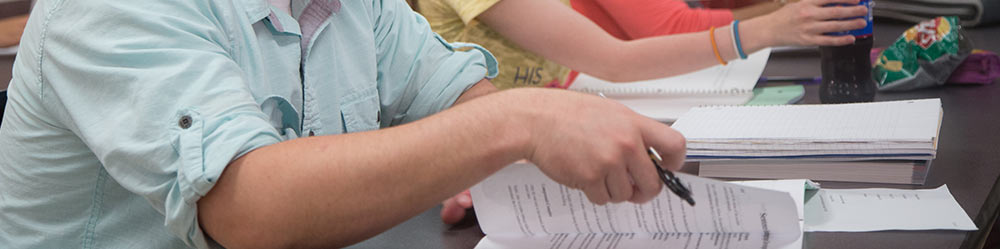
At the Writing Center, our mission is to help all students at MCCC become better writers by providing an opportunity for close and regular contact with a supportive, yet critical audience.
We believe that a writer can learn a good deal by talking to a sensitive and responsive reader before, during, and after writing and rewriting.
The only way to learn how to write well is by writing and rewriting. Because we view writing as a complex process involving the recursive application of a wide range of thinking skills, our writing fellows strive to always listen and engage students in a constructive dialogue as part of the composing process.
The Writing Center is committed to the following principles:
- We will begin where the student is and establish and maintain a rapport that shows an interested concern for the needs of the individual writer.
- We will allow the writer to do the work: we will resist the temptation to become a rewriter. The Writing Fellow recognizes the need for an immediate, constructive response and will suggest strategies for improvement. However, the writer does the work and the consultant monitors and guides the process. We will allow the writer time to find his or her own best way of working.
- We will deal with "high-order" concerns before "low-order" concerns. By high-order concerns we mean such things as thesis or focus, appropriate voice or tone, organization and development of ideas. Low-order concerns would include such things as sentence structure, punctuation, usage and spelling. A student's time is not well spent if he or she works with spelling and punctuation in an assignment that needs to be substantially revised and rewritten because of problems with high-order concerns. We wish to help each writer improve each piece of writing. We are willing to accept small successes, and we will try not to expect too much. We are not miracle workers; we recognize our limitations. In many cases we are dealing with writing problems students have developed over many years. We cannot solve all writing problems in an hour or two – or even in a semester or two.
The Writing Fellows Program was developed in support of writing across the curriculum at MCCC. This means that at MCCC you may be assigned writing (essays, research papers, reports, etc.) in courses that fall under every academic discipline. We encourage all MCCC faculty to use writing as a learning tool. Because of this, we also provide MCCC students, free of charge, the opportunity to consult with writing fellows – successful student writers who are trained and qualified to comment on other students writing – via the Writing Center.
The purpose of the Writing Fellows Program is to help all MCCC students improve their writing through feedback from trained writing tutors who are also students at MCCC. We think that students of all abilities will benefit from peer feedback. Even professional writers seek out and value the comments of their peers.
You will benefit most by consulting with a writing fellow at various stages of your writing project — especially for research papers that may require several major steps toward completion.
Writing Fellows will not write your paper for you, but they will help you write a paper that does the following:
- Follows the directions of the assignment
- Has a clear organization plan
- Focuses on a main point (thesis statement)
- Develops main and supporting points with evidence and logic
- Provides transitions between paragraphs and within paragraphs
- Uses a formal system of documentation
If writing fellows notice significant errors in grammar, punctuation and spelling, they will let you know, but only after thoroughly discussing other aspects of your work that need attention (see list above). If you do not know how to find and correct these errors, writing fellows will help you by showing you editing strategies. Nevertheless, they will not locate and correct all of your errors item by item. That will be your responsibility.
Writing Center tutoring is normally provided by appointment. To make an appointment, call the Student Success Center at (734) 384-4167 or students can also make an appointment online below.
- Log into the MCCC Tutoring Center using your Brightspace credentials.
- Click on “Writing Center” tab for writing and communications tutoring.
- Find an appointment that best fits your schedule and click “Reserve” to save the appointment.
- A confirmation notification will be sent to you.
- Any changes to your appointment should be made one hour in advance.
You can make an appiontment to get help in a wide variety of subject areas including business, humanities, math, science and the social sciences. In addition, academic coaching and study skills support are available. These services are a great resource to help you perform the very best you can in your classes.
What We Will Do (first five minutes of a session)
Ask discovery questions to identify the best starting point for the student’s paper:
• Ask the student preliminary background questions (e.g., instructor’s name, course title, due dates, etc.).
• Ask the student for a written assignment sheet—if one is not available, the Writing Fellow will ask the student for course notes or a verbal description of the assignment.
• Ask what stage of the writing process the student is working on—prewriting, first draft, revision, editing, or documentation.
• Ask the student to identify any weaknesses in the paper (e.g. content, thesis, organization, paragraphing, sentence structure, etc.). While students may not use terms like “thesis,” Writing Fellows are trained to recognize how students might describe their own writing problems.
What We Will Do (20-45 minutes, depending on the length of the session)
Read the entire paper with the student to address high-order concerns (HOCs) or macro issues:
Does the paper
• Follow directions of the assignment.
• Identify a specific purpose and audience.
• Provide a clear thesis (a main idea developed throughout the paper).
• Progress in a clear organized way (grouping similar points under an organization plan controlled by a thesis).
• Develop each idea sufficiently and effectively (using rhetorical approaches—narrative, description, argument, comparison, etc—evidence, and logic to develop the main and supporting ideas with examples and a variety of details).
• Connect paragraphs through the use of transitions and repeated key words.
• Use appropriate language that fits the audience and matches the purpose of the writing.
Check for proper documentation of outside sources of information, such as books and periodicals, if such sources are required by the assignment:
• Ask the student what documentation system he or she is required to use (e.g. MLA, APA, CSE), and make sure the student understands the system.
• Comment on the clarity of separation between what the student’s sources say and what the student says in the paper. Monroe County Community College The Writing Center
• Discuss with the student his or her use of a variety of source notes—summary, paraphrase, direct quote, and graphic.
• Show the student how to “frame” source materials—introduce source material through “signal phrases” (e.g. the author states, John Smith argues)—and complete the source material with parenthetical citations.
• Discuss the differences between “common knowledge” information that does not require attribution or citation and “specific knowledge” information that requires attribution and parenthetical citation.
What We Will Do (if there is time in the session)
Look over the paper with the student for the purpose of “instructional editing” of lowerorder concerns (LOCs) or micro errors:
• Identify common writing problems such as fragments, run-on sentences, subject-verb agreement, pronoun-antecedent agreement, shifts in person, and unclear or awkwardly constructed sentences.
• Focus on a limited number (2 or 3) error types—research shows that most students’ errors occur in patterns (e.g. always confuse the use of apostrophes, misspell homonyms, join sentences with commas, use dependent clauses for sentences, etc.).
• Direct the student to a sentence that contains an example of one of these error types, and have the student read it aloud to see if he or she notices the error.
• Help the student understand the problem, show the student how to consult handbooks or websites to find solutions to the problem, and show the student strategies to avoid the problem in future writing.
• Direct the student to a different part of the paper to identify a reoccurring problem, and have the student attempt to work through the problem/solution without help.
• Suggest the student make another appointment to focus on just this problem if the student continues to struggle with understanding the patterned error.
What We Will Do (last five minutes of the session)
Review the main points of the session and end the session with positive feedback:
• Ask the student to verbally identify two or three writing strengths or weaknesses discussed in the session.
• Ask the student to verbally identify writing strategies the Writing Fellow modeled for the student.
• Ask the student to verbalize how he or she will use these strategies to improve the paper.
• Suggest a follow-up appointment to work on another stage of this paper, a future paper, or writing skills in general.
• Emphasize one writing skill the student does best, and emphasize how that skill can be expanded or applied to other areas of the student’s writing. Monroe County Community College The Writing Center
What We Will Not Do
Proofread a paper (identify and correct each error, item by item)
• Identify errors item by item. Students need to accept ownership of their work and be responsible for their work, errors included.
• Use consultation time to correct individual errors, because there isn’t time to look at each word, it is more important to show students “how” to find and correct their individual errors.
• Encourage student dependency on Writing Fellows for identifying and correcting errors.
• Ignore editing errors in a student’s paper. If serious editing or proofreading problems exist, Writing Fellows will suggest future appointments to address them and work on strategies for correcting errors.
Suggest writing style changes
• Use a thesaurus to change one or two syllable words to multi-syllable words, as this is almost always an ineffective strategy.
• Suggest specific changes for nouns, verbs, or adjectives to improve the student’s writing style (we may, however, ask the student to think of different approaches to word choice).
• Suggest the student rewrite phrases or sentences to suit the Writing Fellow’s writing style choices (we may, however, suggest that a paper is too wordy, too informal, lacking in detail, etc.).
• Rewrite sentences or passages for a student (we will, however, encourage students to use a variety of sentence patterns to create an interesting and flowing writing style).
• Write on a student’s paper for any reason (revising diction, syntax, etc.), which could compromise a student’s ownership of the paper.
Influence the content of the paper
• Suggest that a student add or subtract any specific content in a given paper (we may, however, suggest that more or less development of an idea is needed, or that new ideas should be added to meet length requirements of the assignment).
• Suggest to a student that an instructor “wants” specific ideas or content in a paper (student often incorrectly conclude that writing papers for instructors is formulaic).
• Alter the content of the paper in any way (we will, however, ask questions to determine if the student understands what he or she is writing about and if the issues discussed in the paper have been addressed sufficiently).
• Suggest to a student that the content is correct or incorrect (we will, however, discuss with the student whether or not there is sufficient support for the student’s ideas).
Frequently Asked Questions
Call (734) 384-4167 or schedule online.
Make an appointment to ensure that a writing fellow will be available to work with you.
Use of the Writing Center is free to MCCC students.
Writing fellows at MCCC provide the assistance. These are MCCC students who have been nominated by faculty because of their writing abilities and willingness to work with other students. Writing fellows go through a rigorous training course (Advanced Composition) and continue to develop their skills at workshops and conferences.
If you have an assignment sheet or notes about the assignment, bring them to your session. Depending on how far along you are in your writing, you might bring notes or ideas, a first draft, an outline or whatever you have completed before your appointment. The writing fellow will help you determine which step you can work on next. If you are bringing a draft of your paper, please have it typed rather than written in longhand. It will be easier for you and the writing fellow to work from a typed copy. We do, however, accept handwritten papers. For more information on what to bring, please go to Files section.
No. However, in some cases your instructor may require you to work with a writing fellow or offer you extra credit to do so.
Writing fellows will help you with all stages of the writing process, from prewriting to final revision. The writer and the tutor work together to begin, critique and/or improve the written work in process. Writing fellows can help with essays, research papers, speeches, business reports and just about any other type of writing assignment. While the writing fellows will not edit your paper in any way or rewrite or change anything in your paper, they will teach you strategies for revising and editing of your own work.
Check with your instructor.